Why a Swiss Premium Brand Is Going Offline in China
In 2024, I wrote about Alpine White, the Swiss oral care brand founded by Alexander and Reto Wälchli, and its early steps into China: a flagship store on Tmall Global, presence on Xiaohongshu, WeChat and Douyin, and a product registration process that was still underway. Two years on, the picture has changed. The brand, sold in China under the name 乐瑞白 (Lè Ruì Bái), now sits in some of the country's most exclusive supermarkets, at 189 RMB the most expensive toothpaste on the shelf.
Behind that shift is Ma Shiyu, who leads Alpine White's APAC business. We spoke shortly after this year's China Beauty Expo. What followed was one of the most candid conversations I have had about what it actually takes to build a premium Swiss brand in China: why Alpine White moved from cross-border e-commerce into general trade and physical retail, where the surprising money sits, and what she would tell every Swiss founder before they book a booth at their first trade fair.
This conversation is part of the Think East series Swiss Brands in China, spotlighting successful Swiss brands in the world's most demanding consumer market.
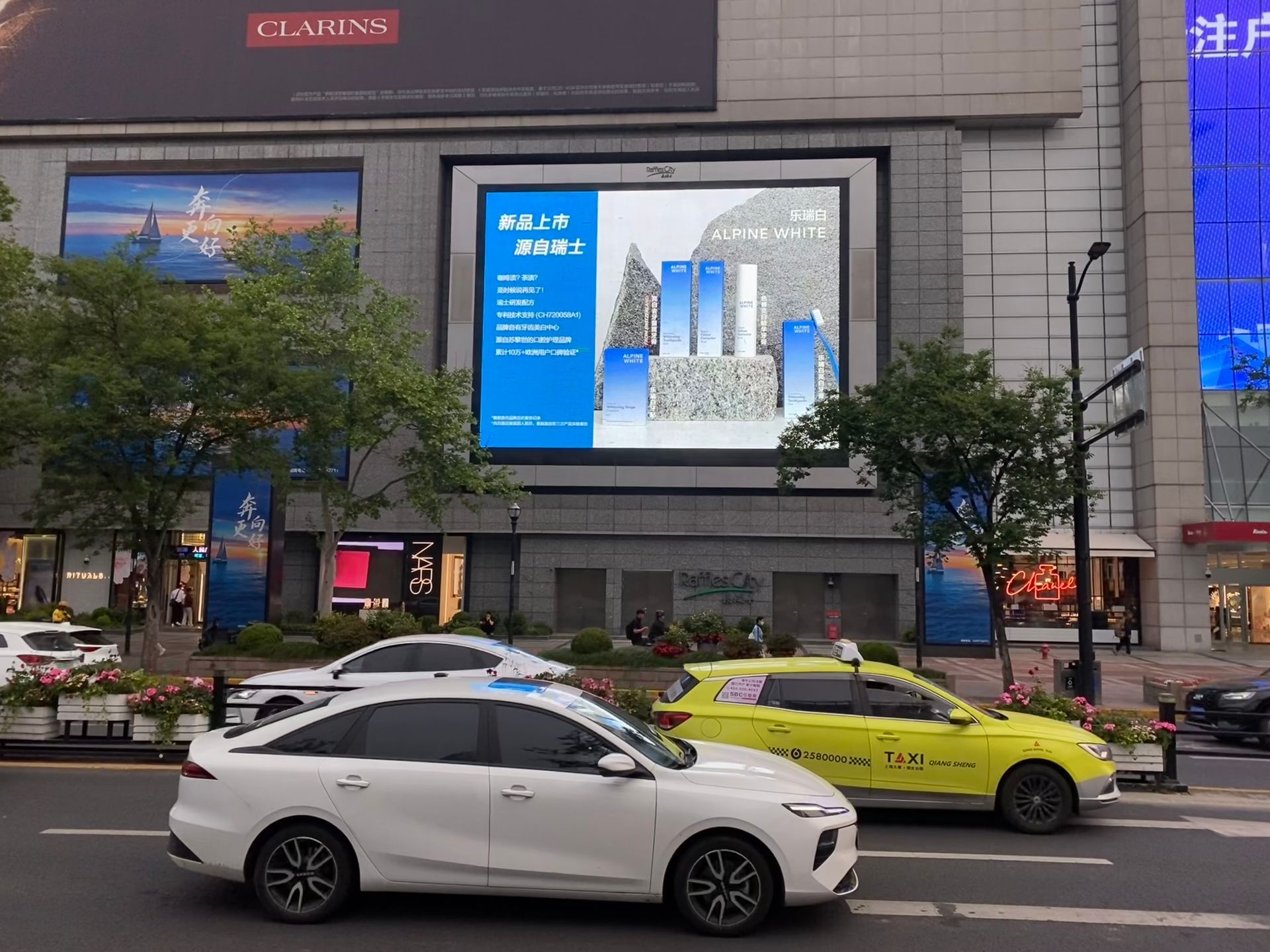
Photo: The 乐瑞白 billboard at Raffles City in Shanghai.
Amy: When I wrote about Alpine White in 2024, you were almost entirely online. What has changed most since then?
Shiyu: The biggest change is our model. In 2024 we were 100% online and all of it cross-border. I would describe it as walking on one leg: our own Tmall Global, WeChat and Xiaohongshu flagship stores, selling through heavy paid promotion. Today, online is around 30% of the business, and the center of gravity has moved to general trade. We have spent two years building a proper distribution system across the country.
From one beauty expo to the next, almost exactly twelve months, we went from a single channel to a whole network of partners: our general distributor, regional agents, channel agents, online agents. The flower opens much wider now.
That is a fundamental shift. What drove it?
A few hard lessons. We had pulled out of Douyin, and we learned that traffic there is simply too expensive. It is heavy investment, livestreaming, paid traffic, basically a money game. When we sat down and calculated input against output for the whole China market, relying on a single online channel and pouring money into promotion was never going to get us where we wanted to be.
Cross-border also has structural limits. The platforms you can use are limited, logistics are awkward, and there is a cap most people outside China have never heard of: every Chinese ID has an annual cross-border purchase limit of 25,000 RMB across all platforms combined. Our customers reach that easily, and once they do, they look for alternatives. That alone pushed us to do general trade properly.
And there was a lesson from Europe. Our biggest sales there come from B2B, from our retail partners ordering, while our own webshop sells comparatively little. So we now treat our online flagship stores as a shop window. They present the product, the brand and the price, and the selling happens across the wider system.
You also made an unusual choice for China: you have pulled back from livestreaming.
Livestreaming tends to compress your price. The big shopping campaigns already require steep discounts just to take part, and hosts usually expect deeper cuts on top of that, often with free gifts. Very quickly, a large part of your margin is gone, and our retail partners cannot operate underneath those prices.
So we have deliberately turned down the sales we take from livestreaming. We are a premium brand. We are not Darlie, and we are not Colgate. We protect our price and our partners instead, and promotions like Double 11 and 618 do not really matter to us any more.
Within physical retail, how do you decide where Alpine White belongs?
It starts with positioning. We are arguably the most expensive toothpaste in China right now, at 189 RMB. Our general distributor has deep experience with European premium oral care brands, so they understood from the start how to place a product like ours. So we thought hard about who our customer is and how she actually shops. She rarely has time to sit in livestream rooms hunting for discounts, and a good part of her spending still happens offline, in places like SKP, Shanghai IFC or Deji in Nanjing.
So our most important channel is high-end import supermarkets: the supermarket below SKP, CitySuper in Shanghai, Ole’, and benchmark locations like Hisense Plaza in Qingdao, where the basement supermarket is among the most expensive in the city. These are precise, premium formats, not hypermarkets and not warehouse clubs.
Beauty stores are where we are putting down roots now. Every province has its own strong chains, all independent systems, so it is painstaking work: you build each relationship, find the right person, bring them in. That is why we are at a channel-focused expo in Zhengzhou this November and one in Hangzhou next year. Dental clinics we would love to enter, because our Swiss DNA is the dental clinic, but the regulation is a world of its own and needs yet another right partner. Pharmacies we have ruled out for now: toothpaste is classified as a cosmetic here, and the pharmacy shopper is looking for medicine, at a very different price point.
Are there cities that surprised you?
Constantly. The obvious targets are Beijing, Shanghai, Guangzhou, Shenzhen. But take Hengdian in Zhejiang, the centre of China's film industry. The city itself is not highly developed, yet our beauty store there sometimes outsells a proper premium supermarket. This is why we fought so hard to complete product registration, which took twelve to eighteen months per product. Some of ours are efficacy products requiring thorough clinical tests, which alone take eight to ten months. It is a long road and few brands walk it. But once registration is done, the whole country opens up, and China's potential is almost limitless.
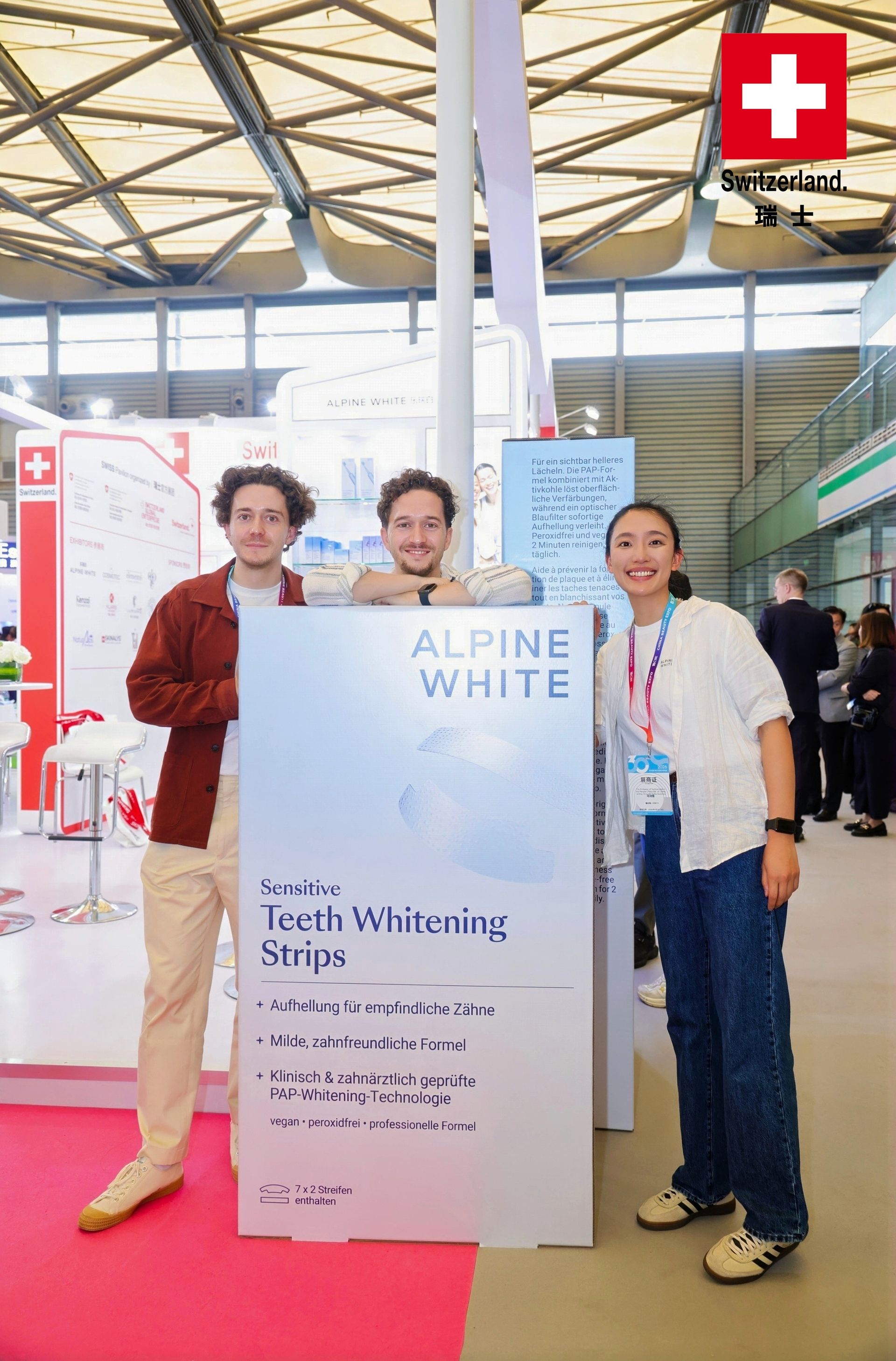
Photo: The Alpine White team at this year's China Beauty Expo in Shanghai.
Alongside distribution, how are you building the brand itself?
We do what a genuine foreign brand should do. We stay fully compliant, and we bring our world to China: our Swiss videos, footage from our European and Brazilian markets, the Swiss mountains in our artwork, the Swiss flag where we are permitted to use it. We also ran outdoor campaigns in Beijing and Shanghai this spring. Does a billboard convert directly? No. But it touches the consumer again and again.
There is a moment that stayed with me. We had a long billboard in a Beijing subway corridor, on an escalator everyone has to take. I went to see it in April, and while I stood there, a group of young women coming back from lunch read our name off the poster, out loud: Lè Ruì Bái. And I thought: that already works. I do not need you to buy the product today. I need you to know me, to say my name, so that an impression forms. For a young brand in this market, awareness comes first. Then we talk about sales.
When we last spoke, teeth whitening barely existed as a category in China. Has that changed?
Honestly, very little. Whitening strips are still a small, niche category, so we keep cultivating it, mainly through genuine seeding on Xiaohongshu: real users and creators who actually use the product and write honest notes. Since January we have done this seriously every single month. We once thought we could skip this work. You cannot.
The category itself is rising. People used to solve tooth discolouration in damaging ways, like veneers, which are irreversible. Coffee consumption is climbing fast, so the problem is growing, and we want to be the safe answer when it appears. But this grows slowly, over time. Two years is not long in this market. You have to hold steady and not get impatient. We are five years in, and we intend to reach ten and fifteen.
Your Chinese team ran hours of in-depth interviews with more than twenty of your own customers last year. What did that teach you?
That you only get truly honest feedback if you go and ask for it. Our Chinese team sat down with more than twenty real customers, people who had bought from our flagship store, for hours of in-depth interviews. The most striking finding: the deep blue packaging that Switzerland had always considered beautiful read as cheap to Chinese consumers, and not at all premium. So we are changing it this year. The new packaging looks far more high-end.
Our partners catch things too. Our whitening strip boxes could not stand upright on a shelf without a prop. Our three toothpastes came in identical colours, so shoppers could not tell them apart. We changed that. We used to force-feed the consumer: I have a steamed bun, I hand it to you and tell you it is good. Now, if I have a bun, I ask whether you would rather have it as a burger or a wrap. Chinese consumers are among the most discerning in the world, and the feedback loop here is immediate. One unhappy post on Xiaohongshu can ferment overnight. In Europe a complaint disappears into an email inbox with a 48-hour response time. Here, there is no buffer. I genuinely respect that. It means they take your product seriously.
You meet many European brands at trade fairs. What do Swiss brands most often get wrong about China?
Let me use your platform to say one thing to my peers: China is probably the most difficult market in the world for FMCG brands. I have not seen a harder one. You compete with brands from everywhere, domestic and international, in every category. And Chinese products are strong now. The factories learn astonishingly fast, and the marketing being done by local teams is something you cannot picture from Europe.
The second mistake is the belief that a good product wins on its own, without investment. My rule is simple: time is money. If your product really is good, can you endure? Can you support the brand in China for three to five years, five to ten? If you can, I am convinced there will be a moment in that decade when the product shines and gets found. Even now, there is still a lot of optimism about quick success in China, the idea that you might sell tens of millions in the first year. Realistically, that is not how it works. The era of quick money is over. What remains is a market that rewards seriousness.
So what should a Swiss founder with a limited budget actually do?
First, know your consumer. That homework is unavoidable. Then choose one or two platforms that fit your brand and do them properly. For a premium Swiss brand I would say Tmall and Xiaohongshu: build your store well, choose your path carefully, and invest in real seeding, real users trying your product and writing about it. There are lean ways to do this. Resist everything else, however tempting the numbers sound, and give it a year or two. You will pay some tuition at the start. If you learn from it, adjust. If not, cut your losses in time.
What is next for Alpine White in China?
More depth. We are bringing more products to China and registering each one properly: an anti-plaque toothpaste and a sensitivity relief toothpaste. We want to do oral care in fine detail, always on the safe side of whitening. On channels, we have covered only the tip of the iceberg, so we keep building. And we continue the brand work: collaborations with relevant communities, such as sports events and concerts, and above all the patient, genuine content that earns trust. The people who carry imported products in China have real affection for foreign brands. Our job is to be worth that affection: reliable supply, full compliance, and a product that delivers.
Last question. One piece of advice for a Swiss premium brand about to enter China?
Be open-minded, and do not be arrogant. And before any strategy: go. The founder may just spend a week in Beijing and a week in Shanghai. It is visa-free now. Set up WeChat Pay, order on Meituan, take a Didi, ride the subway and watch how people actually buy. One real visit beats a hundred pages of market research. As Europeans, it is genuinely hard to picture the sheer size of China and how much it varies from place to place. Until you see it, you cannot understand why every link in this market, online, social, retail, needs its own partner.
And when you build your team, have someone in it who truly understands China, ideally someone Chinese. You need a real foot on the ground. It saves you years of detours. Go once, and the arrogance falls away. Come back with the real feeling, then decide. That decision will be the right one.
Alpine White products are available in China under the name 乐瑞白 through Tmall and selected premium retailers. This conversation was held in Chinese and has been edited and condensed for clarity.
Are you building a brand between Europe and Asia and want to be featured in our next interview? Get in touch now.