The New Rules of Desirability: Inside China’s She Economy
China accounts for about 62% of the world’s self-made women billionaires, according to the Hurun Global Rich List. At the same time, data from the Global Entrepreneurship Monitor's 2023/2024 report shows that China is among the rare economies worldwide where women's startup rates match or exceed those of men, and it has a generation of university graduates that is now majority female. It is also a country where the government actively encourages women to marry earlier, have more children, and return to domestic life. The she economy lives in the tension between those two realities.
China's female consumer base controls an estimated $1.4 trillion in annual spending, according to Accenture research. They influence 70% of all household purchases and, in a shift that would have been culturally unimaginable a generation ago, now direct a majority of their personal spending toward their own needs rather than those of their families, according to JD.com research.
Who They Are
The she economy did not emerge from a single city or a single demographic. Its most visible architects sit at the very top of global wealth rankings. Zhong Huijuan left a job as a chemistry teacher to found Hansoh Pharmaceutical in Jiangsu, building it into one of China's leading oncology and psychotropic drug companies; by mid-2025 she ranked first in Asia and third globally on Forbes' list of self-made women billionaires, with a fortune of approximately $19.7 billion. Wu Yajun arrived at entrepreneurship from a different direction: factory floor technician earning $16 a month, then property journalist, before co-founding Longfor Properties in Chongqing in 1993, a company that grew into one of China's largest real estate developers. Wang Laichun, chairwoman of Luxshare Precision Industry, spent years on Foxconn's assembly lines before building the company that now manufactures Apple's AirPods and rivals Foxconn across Apple's supply chain; the 2024 Fortune list ranked her the most powerful woman in business in Asia.
The geographic picture is equally important. A significant share of Chinese female internet users now live outside the traditional tier-one cities. Hangzhou, Chengdu, Wuhan, Xi'an, Nanjing: these are not secondary markets. They are where consumption habits are being formed, where new platforms find their earliest adopters, and where brand loyalty, or its absence, is decided. A 32-year-old finance professional in Hangzhou and a 28-year-old designer in Chengdu may have similar purchasing power and entirely different ideas of what makes a product worth owning.
Spending on the Self
The founders described above illustrate the female economic power at the top. The same shift is also visible in how women are spending. One of the most structurally significant shift in the she economy is the direction of spending. In 2023, Chinese women purchased 8.23 million vehicles, up 10.6% year-on-year, according to Yiche Research Institute, a category that was almost exclusively male-dominated a decade ago. Women are also increasingly central in homebuying decisions. Surveys suggest that more than 80% of property purchases now involve female decision-makers. Wellness, travel, and self-education have become the fastest-growing spending categories among urban women under 40.
This is not consumption for its own sake. These spending patterns reflect a generation of women who came of age in a different educational and economic environment. Women now account for 63% of all higher education enrolment, outnumbering men at undergraduate level and in several postgraduate disciplines, according to China's Ministry of Education. They are applying the same rigour to purchases as to careers. The luxury resale market is part of this logic: platforms like Plum, which specialises in pre-owned luxury goods, are overwhelmingly female-driven, combining value-consciousness with the kind of careful curation that defines this cohort's relationship with objects.
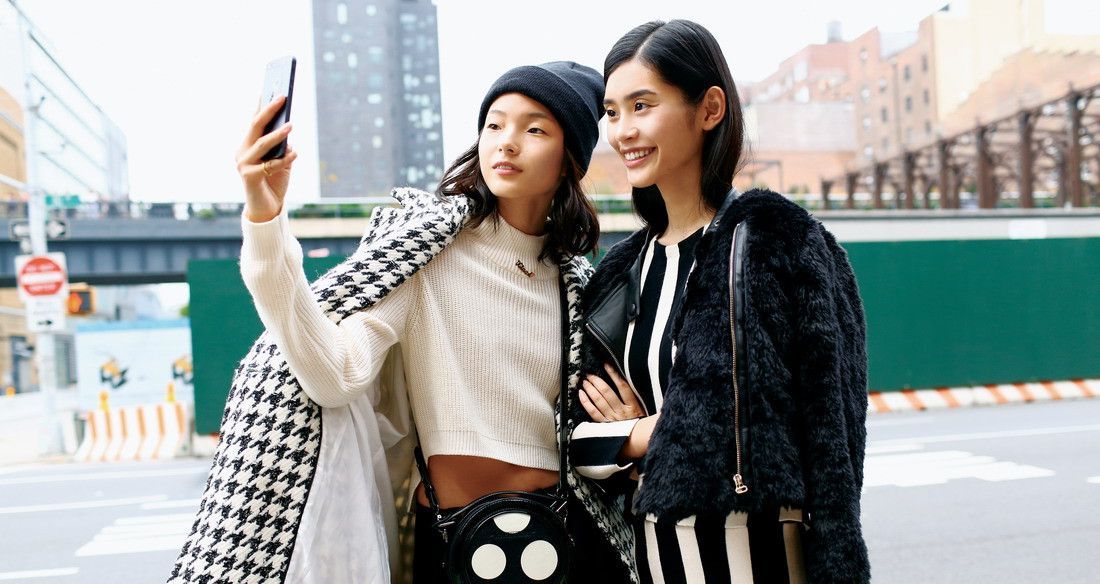
Photo: Chinese models taking selfies
Gen Z
The next inflection point is already visible. Chinese Gen Z women are the least brand-loyal consumer group in the country's history, the most digitally fluent, and the most likely to make a purchase decision based on peer validation rather than brand prestige. The platform where much of this plays out, Xiaohongshu, functions less as social media and more as a living index of taste: search results for any luxury product surface not brand campaigns but peer assessments, often from women with no commercial relationship to the brand at all, describing the weight of the fabric, the durability of the hardware, the gap between marketing image and reality. For luxury brands accustomed to controlling their narrative, it is a fundamentally new environment. According to Tencent's 2024 Luxury Report, Gen Z and millennials together account for approximately 70% of luxury spending in China. The luxury market itself has been through a turbulent recalibration: after contracting 17% to 19% in 2024, it shrank a further 3% to 5% in 2025, according to Bain's January 2026 China Personal Luxury Report. Yet Bain also describes 2025 as a year in which the market began to stabilise, with recovery signals emerging in the second half, and forecasts modest growth returning in 2026. Chinese nationals still account for roughly 23% of global luxury demand, per Bernstein, making the trajectory of this consumer base among the most closely watched questions in the industry.
What the forecast does not capture is the qualitative shift driving it. Conspicuous consumption, the logo-forward purchasing behaviour that defined the early 2000s luxury boom in China, has largely given way to something more considered. For high-net-worth women, quality of material and craft provenance have become the primary criteria. In the premium segment, experience and cultural resonance drive decisions: a bespoke wellness retreat, a limited-edition collaboration with a Chinese contemporary artist, a brand whose communication demonstrates genuine knowledge of the culture it is entering. For Gen Z, meaning and community come first. Pop Mart, whose collectible figures are bought by a 75% female customer base, understood this before most luxury houses did.
The Contradictions
The narrative the Chinese state projects about women tends to emphasise harmony and domesticity. The she economy, to a significant degree, tells a different story. Marriage rates have fallen for eight consecutive years. China's birth rate hit a record low in 2025, with just 7.9 million babies born, down from 9.5 million the previous year, according to China's National Bureau of Statistics. The fertility rate, estimated at around 1.0, places China alongside South Korea and Japan at the bottom of global rankings. Government incentives for childbirth, including extended leave and cash subsidies across multiple provinces, have produced little measurable change in behaviour. Many educated urban women are opting out of the marriage timeline because the economic and personal case for it has weakened. A millennial, affluent woman with her own income, her own apartment, and her own professional identity has a different relationship to dependence than her mother did.
The ceiling above the she economy is still there. In state-owned enterprises, which still dominate large swathes of banking, energy, and heavy industry, women hold a fraction of board and senior executive seats. The constitutional guarantee of gender equality in China has not translated into corporate governance reform at the top of the state sector. The private economy, by contrast, has been more permeable, and it is no coincidence that most of China's prominent female founders and executives have built their careers inside the private sector. Whether the next decade extends that openness or narrows it, is one of the more consequential unanswered questions in Chinese business.
What is not in question is the scale and direction of what has already shifted. A younger generation is coming up behind these founders and executives that is more independent, more discerning, and increasingly unwilling to grant a brand loyalty it has not earned. The
she economy does not stand still. Neither does the woman driving it, and she is considerably more interesting than most western assumptions give her credit for.
Amy Weng is a China market expert and founder of Think East. She advises luxury houses, consumer brands, Swiss institutions, and senior executives seeking a deeper understanding of the Chinese market. Amy speaks regularly on topics including China’s digital landscape, Young China, and the forces reshaping Chinese consumer culture. Her work bridges the gap between Western brands and one of the world’s most sophisticated consumer audiences.
This article was originally published on Luxury Tribune, the reference media for the global luxury industry.